Pandemic Love Languages

This is to pick up on a theme I brushed past in my post, Beating Chronic Pandemic Micro-Trauma: the broader question of how we find resilience in the face of layer upon layer of stress that each day paints on top of us like a fresh coat of varnish, leaving us just a little heavier, a little more distant from everything around us, and a little less able to breathe.

One thing that gets us through pandemic is love.
Dr Gary Chapman writes about five “love languages” (ways to express or receive love): Words of Affirmation, Acts of Service, Physical Gifts, Quality Time, and Physical Touch. I’ve found the concept it adapts to many kinds of situations and relationships among people, but I’ve been thinking about it again over the last few days.

We’ve got social media; we’ve got zoom; we’ve got couriers; we’ve got email; we’ve got wi-fi; we’ve got voice-over-IP; we’ve got old-fashioned phone. We’ve never had more ways to…be disconnected from each other.

And yet…I’m so grateful for all the shining moments over the past ten months when my family and I have found our way through.

I miss my family. They are all in Canada, where I was born. I’ve had some sharp, painful moments of missing them over the past year. The first family pandemic zoom call to celebrate my brother Dave’s birthday left me feeling bleak: there were so many emotions that none of us talked about. 

I remember a feeling of gut punch the moment I heard on the radio in May that the Canadian border was closed indefinitely: that was the moment I knew beyond a doubt that I would not be going home for Christmas. 

I’m grateful for a chat thread my brother Dave set up in March. We four adult siblings and my mom exchanged more candid communication in the first ten days than we had in the previous ten years. Words of affirmation, for sure.

One of my pandemic heroes is Matt, the guy who owns the UPS Store on Duke Street, about three and a half miles from my house. He’s been my shipping lifeline to my family. Sometime in April, I did a little bit of baking and put together packages of cookies — maybe one or two per person (but they were really good cookies; who wouldn’t like something called “Fudge Ecstasies”?). The shipping must have cost over $150 for ingredients that were worth no more than $15. I left the UPS store and I cried as I walked home. 

Weeks later, my brother Lorne told me how much he appreciated the package as well as my effort to make and get it there, out of all proportion to the monetary value of the shipment on the customs declaration.

Trying to find time and emotional space for phone conversations has been challenging, and still is. We’ve all had a lot of days when “on camera” was the last place we wanted to be. So even showing up for that zoom or face time was love as quality time.

Sometimes we send and receive things. I’ve come to realize that the gifts of imperfection include the imperfection of gifts: when we give with the deepest of heartfelt intention in the full faith that our receivers will receive with that same spirit.

Really early on, bringing groceries to the most at-risk people in our bubble, an act of service, was as basic an act of love as one might imagine.
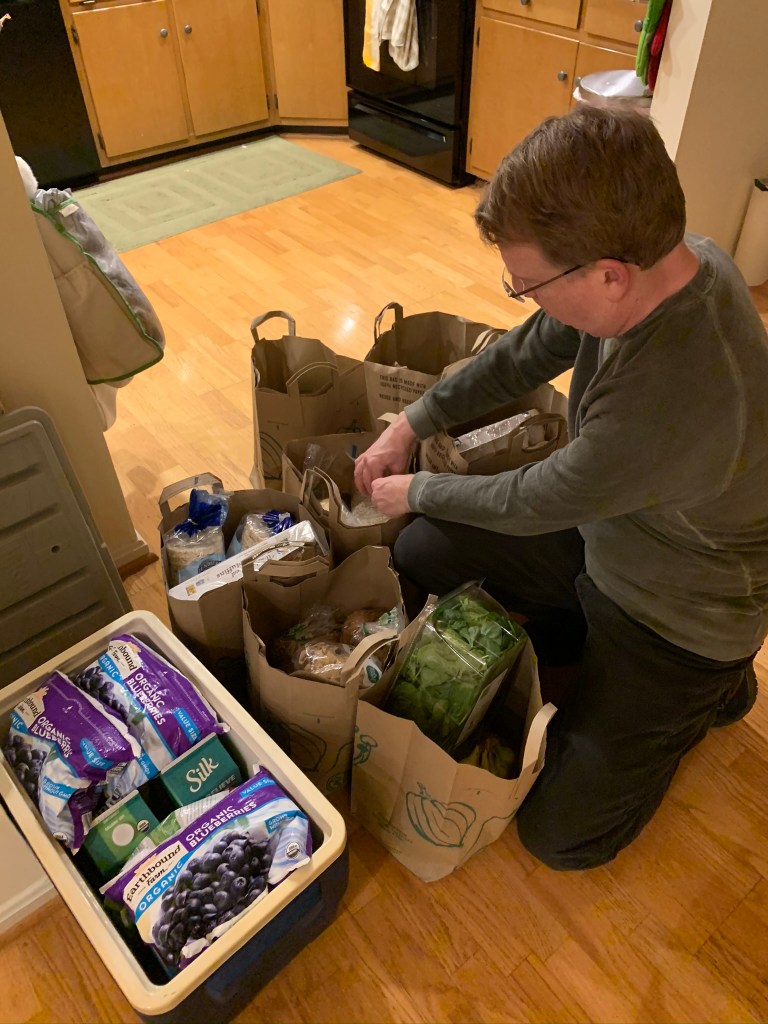
I would send my sibs and nieces and nephews a random package for no particular reason. 

I find gift-giving — when the gifts are physical items — challenging, probably because my perfectionist self wants every gift I give to be the perfect thing that someone has always wanted. 

My sister is very good at finding amazing gifts that I love – offbeat sweaters and scarves and socks — even when I say I don’t need things.

I sent a vial of my very favorite natural-good-for-you moisturizing lip gloss to the niece who I later discovered to be a resolute non-wearer of makeup.  I hope she felt loved when she got it. My nephew understood my intention in including him on the gift tag for the coffeemaker I sent their household even though he doesn’t drink coffee. My sister sent me a picture of their family holding the handmade ceramic mugs I sent them. My sister in law sent me a t-shirt with Canada-US graphics on it. I sent my brother’s family pictures of the travel diary they sent me. I’ve sent my brother two shipments of the most intense coffee I could find by mail order…simply because I know that’s something that sustains him (and if he’s sustained, that’s gotta make the whole household just a little cheerier).

Pandemic gifts have many forms that aren’t physical, too. 

My Baltimore partner and I have given each other the gift of quality time on our Friday afternoon forest walks.

Many friends also gave me the gifts of quality time or acts of service, with technical assistance, generosity, and patience when I was at my wits’ end.

To ease the stress of building business in a pandemic, I took the time and money to produce a monthly free event for my professional community: a discussion group to help them build their skills in human communication.

I spent time mentally pouting (and a lot more time feeling guilty about feeling selfish) about rearranging my own plans and inconveniencing two other people to meet my sister’s eleventh-hour request to host the online family party for my niece Fiona’s high school graduation…and I didn’t even send a gift. Argh. After everyone logged off, I cried for half an hour. I felt devastated for Fiona, sitting on the couch in the living room in her prom gown beside her proud and loving parents watching a shared-screen video from the link that the school had sent the families to play that night. Life wasn’t supposed to be that way.

I didn’t even manage to send a gift — wasn’t that what family does for graduations? Maybe I could look at my gift as being an act of service that created quality time: hosting the zoom that brought everybody together.  

In January, my brother asked me if I might edit my nephew Simon’s newest project: a near-daily sports blog. I was happy to do it, expecting nothing in return. What I’ve gotten has been precious: not only the chance to see a young writer bloom, and the experience of deeper connection with my nephew, on text and by phone, but also the inspiration to break out of a stall and start to write again for myself and for you.

Then there’s the love language that’s in especially short supply.

Last week, I ran across some images I’d taken in February of 2020. I had gone to New Jersey to see the debut of a friend’s off-Broadway play. I had strolled among hundreds of people enjoying huge animated sculptures at a brilliant festival of lights to honor the Lunar New Year. Looking at the images, I was taken aback by how vivid the images were, as well as my memories of the feelings, of those moments. I guess I had locked away the recollections, to say nothing of the feelings, of these everyday experiences that were about to become so coveted.

So much was about to happen, and I had no idea. None of us did. What might we have done differently to savour those moments if we’d known what was coming?

On that chat a couple days ago, I shared this meme, and you can see what my bro wrote back.
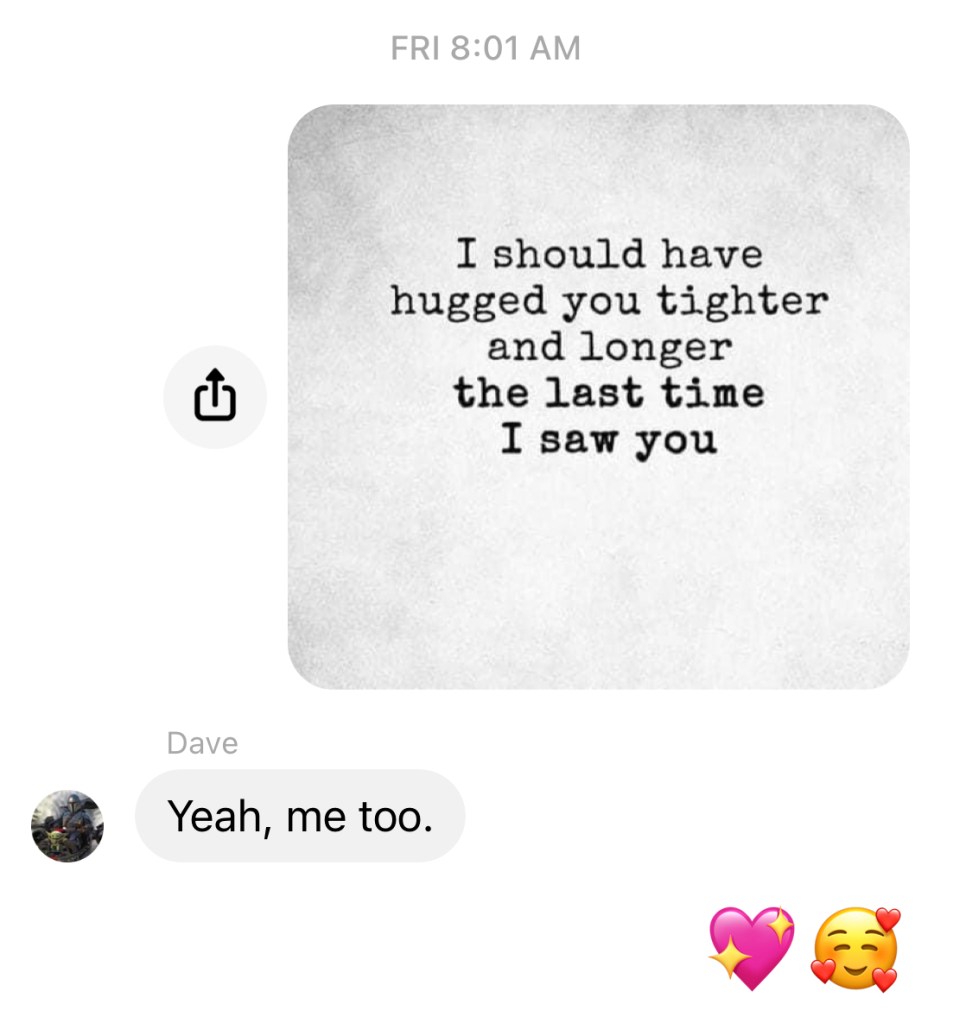
I had myself a little moment, there. I didn’t know he felt that way. It meant the world to me to know. 

What new dialects of love languages has pandemic brought to your life?
Beating Chronic Pandemic Micro-Trauma

What’s Chronic Pandemic Micro-Trauma?

Disclaimer: I’m not a mental health professional, a psychologist, or a specialist in traumatic disorders.  I’m a human who feels things, reads things, notices things, and thinks about stuff. My happy place is the primordial ooze of the creative process, making non-linear connections and wondering why things are and how things work.

We’re coming up on a whole year of pandemic. 

Way back in April of 2020, I noticed both that I was just more tired, for no reason I could figure, and that I was also working and working and working super long hours. Sound familiar?

As the months went on, psychologists and mental health professionals observed that one common response to the shock and stress of pandemic was to numb our feelings by overworking. Millions of people who were in jobs that they could do from home upended their regular work life and went through multiple iterations of adapting to Life Unexpected. The shift to work-from-home — for those of us fortunate enough to be able to do that — was hard and disruptive for dozens of reasons. If you’re like me, you tried a lot, failed a bunch, learned more, and are still figuring out how to make the best of it.

I have a LOT of thoughts about the pandemic work-from-home experience, and I’ll share those another day: what’s temporary, and what I think is gone forever, what will be forever changed, and what will come back (whether in its original form, or evolved) as things open up again.

I have a bad habit of developing theories — even good ones — telling other people about them, and not actually taking my own advice. 

Here’s the theory I had and the advice I didn’t take. Remember I said I’m a person who has for most of my life placed a high value on productivity? The more you can get done, smarter and more worthy you must be? I want to say right up front that that’s not really a great way to look at either myself or other people in my life, and I’m working on changing that (the list of stuff I’m working on is long).

Pandemic represents layers and layers of stress, whether we realize it or just pretend it’s not happening. That stress kicks the stuffing out of us, and it lives in our bodies (see The Body Keeps The Score for more on that). So if we are treating ourselves compassionately — because we are not machines; if we keep pushing through, we break — the only way we can sustain ourselves is to dial back our expectations of what we can accomplish in a day by, say, about 30%.

Then, the same thing is happening to everybody around us. That means we need to have extra emotional bandwidth, conversation time, empathy, for everyone we’re talking to. We have to be more open to hear about what is going on for them, to routinely ask the question, “First of all, how ARE you?” and to genuinely care about the answer. We have to allow for all kinds of things to derail our schedules and plans because people we work with are having Things Happen to them, their friends and loved ones, because of pandemic, and we have to take care of each other because that’s what our responsibility is to each other as humans.

And so we also need to dial back that productivity expectation by another, say, 30%.

Nice theory. Lots of people like it! 

But this is part of what I call Chronic Pandemic Micro Trauma, and it takes a lot of self care and awareness and mindfulness and self compassion to address.

Me, I pushed through and pushed through, interrupted by erratic mid-day meltdowns and 4 AM ugly crying jags…until last fall, when I had to face the fact that, by noon on Fridays, I was cooked. 

I knew something had to change when I spend five hours trying to write a four item to do list. 

Not do the list. Just WRITE the list.

NEW PLAN: Since October, I’ve shut the office at noon.

I have lunch.

And in the weeks I’m in Baltimore, my bubble mate and I go for a hike. 

We never end up walking more than two or three miles because we keep stopping to take pictures. We get completely immersed in the beauty of the natural world and bring back images to savor and share.

It’s been life affirming.

What do YOU do that gets you through?

Mindfulness Meta-Irony

Lest anyone think I claim to be an enlightened life form, I will share the darker underside of yesterday’s post.

Remember the gremlins I mentioned? 

Seems like they sneaked up through the first class section and hijacked the aircraft while I thought I was the pilot in command yesterday.

I thought I’d made the most of my day, even if I did over-run my target end-of-day: at least I noticed I missed the goal, and even took some time to figure out why. Surely that was a win, right?

Except.

Even as I was writing about noticing the insidious pattern of trying to beat “not good enough,” and the effect that can have on people I love…

…I wasn’t noticing that I was in the throes of doing more of exactly what I said I didn’t want to do.

I no sooner stopped struggling to stuff a ten pound professional day into a five pound work day bag than I changed gears to do it all over again with the personal side. 

Because I’d set myself this challenge to write a personal blog (expected by nobody but me, but which I’d decided the entire world was hovering to pass judgement upon me, waiting and watching and fully expecting me to fail), I had also decided that nothing would stop me from getting all the things done in the day that were on the list. 

Things. As if the quality of my life would somehow be better, my value as a human being would be greater, if I checked one more thing off a list.

I pushed through — which is never a good sign, for me; by the time I notice I’m pushing, I should long since have stopped, and there’s probably something else going off the rails that I just hadn’t noticed.

I’m lucky to be living through pandemic as part of a five-person, four-household bubble of humans. We are able to spend time together, visit, sit on each other’s sofas, chat, hug, get groceries or bake for each other, because we all agree on the rules for staying safe. When I’m visiting with one of my bubble-mates, we both work hard separately all day, and don’t see that much of each other. Time together on the sofa at the end of the day, whether we’re chatting or watching something together, being fully present with each other, is a vital, nurturing, part of our day, and sustains that relationship.

I staggered over to the sofa and opened my laptop and kept banging out my blog post. We were sitting next to each other but I might as well have been on another planet as far as he was concerned. He had looked forward to that time all day…and he had set aside a couple hours of time he would otherwise be working to spend that time with me.

In effect, I decided that winning an unwinnable a contest with my oldest gremlins, who are never nice, was more important than being loved by someone right in front of me.

And I truly didn’t appreciate how hurt he was until he came out and told me.

I hate failing at caring for and about the people I love.

I felt shattered at having ended my day not only exhausted, but also defeated because I had hurt someone I cared about.

I can never get that time back.

But I am grateful to have forgiveness, and found some self-compassion and more mindfulness today.

I traded off the workout time for the blog time, and didn’t try to do everything today.

I have two minutes to find the picture to go with this blog, and I’m done.

I’ll talk more about pandemic micro trauma later.

The End Of The Day

I have a hard time deciding when to end my day. Why? Why does it matter, is it a problem, and is it a problem worth solving?

I began my self-imposed challenge wondering how it is that we lose the courage to show up real, to be who we are. What are the forces that erode the natural energy and naive invincibility that we come into the world with?

Where do the voices come from? I’m fortunate to have worked with counselors and coaches over the years and had great experiences with them. One of my counselors recommended Richard Carson’s book, “Taming Your Gremlin: A Surprisingly Simple Method For Getting Out Of Your Own Way.” So “gremlins” are my nickname for the horde of cunning, devious, vicious, voices that murmur and mumble, chatter and chant, and whisper their way through my day. Which might be manageable if they didn’t also slink their way into my sleep, and lie in wait for the witching hour: four in the morning (about which more another day).

The messages that hammer away relentlessly, telling us we are less, we are not enough? I know it’s not just me, but does everybody hear them? My husband is very familiar with these voices but I think only by reputation, because he’s the one who dispenses the hugs at four in the morning when I wake up too anxious to fall back to sleep on my own.

He’s utterly unequivocal about the voices.

“They lie,” he says flatly.

I just realized he might be one of those people who doesn’t actually hear such voices himself. I wonder whether some people have such a strong sense of self, or a vision of the purpose for their lives, or internal guiding light, that the internal critical voice that sows self-doubt year after year in many minds including mine finds no place to be nurtured in theirs.

I mentioned a chorus of voices. They have specialties. One of the oldest voices is “not good enough.” And I’m tired of it. Literally exhausted.

Where did that one come from?

In pretty much every part of my life, my interests range widely. I like to adventure, to explore. While I like to be good at everything I do, I love learning enough that I am willing to try something new and be terrible at it when I start because that’s where learning begins.

One of the biggest apprehensions I had about starting a business was that I struggle to know what “enough” looked like. My parents wanted the best for me and all their kids. Being raised by parents who had struggled through the Depression of the 1920’s, my sense was they were driven to encourage their kids do better than they and their parents had done, to strive to achieve. Whether that push was overt, or something I just absorbed by osmosis, somewhere pretty early in life I inherited one of my oldest gremlins: the one that says, “Not good enough.”

For most of my life, I’ve placed a high value on productivity — particularly my own. A good day is a day when I get a lot done.

That’s where the slippery slope begins.

If a good day is one where I get a lot done, then surely a great day is one when I get more done, right? Workity workity workity workity work! More work got me promotion and recognition and opportunities and credibility and the chance to explore and lead fun projects! The possibilities were endless. The harder I worked, the more I opportunity I found to… well, really, work harder. I hit the salary cap. I wasn’t really working for the money. I told myself I was giving my all to serve my country, as a Trade Commissioner for the Canadian Embassy, helping thousands of Canadian companies who wanted to win U.S. Federal contracts.

And, yeah, I was doing that. But, looking back, I was also deeply hooked on trying to satisfy the voice that kept whispering, “not good enough.” There wasn’t any line that I could draw that I believed would be the point where I could say I’d given enough to serve my country. What I thought of as my sense of duty was endless.

Then came the time, in 2003, when I started my own business. Then, I didn’t have the motivation of patriotic duty. There was the lure of working hard enough (or maybe smart enough) to make endless amounts of money.

Ah, the lure of the American dream of entrepreneurship.

So, fast forward nearly twenty years. It’s 4:30. The time I told myself I was going to stop doing tasks, and organize my lists for tomorrow.

Pandemic has been kicking the stuffing out of all of us for almost a year. I know intellectually that I just can’t expect to try to get as much done in any given day, but apparently that’s a hard habit to break…until it’s really started breaking me.

I. Am. Tired.

Today was the end of Wednesday. There were three proposals I had promised to people in the conversations I’d had today, and one proposal that I hadn’t gotten around to sending out that I’d promised last Friday.

It wasn’t like I got paid for that time. The work I was doing was all directed toward winning business. I spent my afternoon in a flurried cycle of conversations and follow up proposals. That’s a pretty good way to spend time: if I talk to enough people, some of them say yes, and then I do have the chance to get paid for my efforts.

No proposals, no responses; no responses, no yeses; no yesses, no contracts; no contracts, no income, no business.

Oh my. Just look at that narrative: the downward spiral. “For want of a nail, the horse was lost,” begins the story. Clearly, four proposals were the only thing standing between me and the abyss. And they all take longer at the end of the day when I’m tired. But surely it’s a better day if I get more finished AND push myself back from the abyss, right.

Wait: who put the abyss there?

Who promised those proposals? Who set that deadline?

Uh, me.

Ah, but what is that “more” costing me? Or, put another way, what am I getting for the 90 minutes I decided (for it is my choice) to work past the time I promised myself would be the end of the day?

Mostly what I got was just breaking my promise to me. And gave another win to the “not good enough” voice.

So starting tomorrow (less than two hours from now), I can make a more realistic — more humane — promise of when I will get things to people. So that I’m taking better care of me so I can take better care of the other people in my life, including my loved ones and friends as well as my team and clients and prospects.

What do I get when I make a different choice than workityworkitywork?

I get more time to be in places like the image up top.

You know what else?

I’m grateful for all the I learned today, including in reflecting as I write this.

And grateful to have another day tomorrow to try again.

Make Generosity Contagious

I’ve been working on reviving #Fearless Friday, my LinkedIn initiative to regularly promote my “competi-mates”, and I’m finally getting into the rhythm of it. When I posted yesterday and asked who else was willing to join me in promoting a competitor on Fridays, four or five people said, “I’m in!” I was thrilled. I would love to bring a boost of generosity to GovCon. It takes courage to promote someone else in a social media world that can seem relentlessly self-promoting. What might happen if you use your good will and visibility to tell the world why someone else is head and shoulders above the crowd?

My bet is that you’d be surprised. And that the surprise will be amazing.

Here’s a question for you: is opportunity more like pie, or dough?

At the beginning of 2019, I started promoting my competitors.

Yup. On Fridays, I recorded and posted a two-minute video promoting other experts in the my professional field. I only stopped because I got disorganized and distracted. But the idea has stayed with me, and has come back with force this year.

What was I thinking? Well, it’s like this:

I don’t do everything. There are so many kinds of expertise somebody needs to be successful in Federal contracting. I have dozens of smart friends who have very deep expertise in fields that I know just enough to know how much I don’t know. My value comes not just from what I know, but my willingness to tell you what I don’t know, and my ability to pinpoint who does know that.

There are thousands of companies competing for Federal contracts. There are dozens of consulting companies who provide services and databases and events to help them win those contracts.

Federal contracting is HARD. People need good help, good advice, to be successful. I’m not the right resource for everybody, and I couldn’t serve them all even if I wanted to.

When I say, “Here’s someone who’s really smart at this thing. Here’s why I like them, and I think they’re an expert who might be right for you sometime,” I’m also saying, “These folks know things that I don’t know. There are all kinds of things I’m not good at!”

Not every prospect is a great fit for me. More often than not, I refer people to some other resource or company that’s a better fit. That leaves me open to serve someone who’s exactly right for me. By being generous — willing to send business to competitors — I get to be top of mind another day.

It takes courage to spend time and effort shining the spotlight on someone else. But I believe the Universe pays attention, and is a generous place. I’m committed to living in a world of abundance. Even when things happen that I don’t understand in the moment. Even when things don’t turn out the way I imagine.

Opportunity: do you think of it as pie, or dough?

I believe that opportunity is not pie: it’s not zero sum, where more for you means less for me.

I believe in a world where opportunity is dough: add warmth, and it rises, making more to feed us all.

I’m also the master of the extended metaphor, so I’ll close with this idea: what if we all treated opportunity like sourdough starter? It’s a basic kind of bread component that you can make yourself out of water and flour, keep feeding and growing and breaking off bits of to use as leavening to make loaf after loaf…for years. My friend Brian Glass, a NASA planetary geologist, is still feeding his family from a sourdough starter he’s been nurturing since college, over four decades ago!

Welcome to my world. Let’s make — and break — bread together sometime soon.

Where Authenticity Begins

Canada-US Border Crossing, The Peace Bridge. December 26th, 2019, Southbound

True north, strong and free. It tugs at me every time I leave. Boundaries are funny things. This is a ragged segue into exploring the edges of authenticity.

I remember being about eight or nine, maybe, standing in church beside my mom and singing the last song at the end of mass. I liked to sing, and I particularly liked to improvise a harmony line while everyone around me was singing the melody. When the song finished and we were getting ready to leave, my mom asked me, “Are you prepared to be an individual?”

I was mystified by the question. Why on earth wouldn’t I be? How could that even be a question?

What could possibly be so difficult to stay standing, speaking or even singing my truth, being who I am in the world, with the courage of a full heart and without apology?

What teaches us shame or fear to be who we are? Why does it take so long to recognize that fear, and why does it take so many years (and hours of therapy) to release those learned fears, and reclaim our fearless four-year old?

This blog post, and the ones I’ll be writing in this month, is part of my quest to explore that a bit.

When I decided to dig a little deeper into what authenticity is, the first article I saw was this one from Harvard Business Review. It hit on a lot of the risks we run as we try to find the zone of authentic connection. It didn’t go nearly so deeply into why authenticity is essential for leadership and for human connection.

But reading it, I was reminded that one can only find or deepens authenticity through — wait for it— embracing imperfection! Only by being willing to try different approaches, and getting feedback and mentorship from others about whether what they see is what we intended to show, can we find our way. And so comes my declaration. As part of my quest to explore authenticity, my goal is, every day in February, to publish a new post on my personal blog

For many years, particularly since the rise of social media, I have struggled with what it means for me to show up as my authentic self in the world. Social media is a place where I build relationships for business as well as stay connected with friends and even make new ones. On one hand, I feel like I have a lot to say. Many of the ideas are interconnected. I find it hard to decide where to end one complete idea without laying out all the backstory with footnotes and references.

I was taking a marketing course recently. We were given an assignment to write the “origin story” of the product or service we were marketing: what was the riveting personal experience that led us to create our offer for our clients? I think I missed the part of the instructions where we were told that the story would be something we could share in about six minutes. I just looked it up: six minutes of spoken narrative is a little under a thousand words.

I kept writing and writing and writing.

By the time I got to twelve thousand words, I realized this wasn’t an origin story. It was therapy.

Being in connection with others is one of my core values. I’ve learned (thank you Brene Brown) that authenticity demands vulnerability. I’ve learned that sharing my ooey gooey messy side is not only okay, but that if I don’t do that — if I just wander through the world all shiny, all “shields up,” then I don’t leave anyone room to come in.

Maybe you’ve heard the phrase, “the cracks are where the light gets in.” Our imperfections are the places where we connect. When I see someone I love, or someone I respect, or someone I admire, struggling with something that I also find hard, I feel closer to them.

It’s not just me, I think. I am not alone.

When I am vulnerable, when I’m willing to share the things I find hard, the things I struggle with, I give someone else the chance to feel that they’re not alone either. Struggling alone, unwilling or unable to ask for help (especially if, like me, you place a high value on achievement, on pleasing others, on getting it perfect…) devolves into isolation, into disconnection.

When in struggle and I find the courage to say to someone, “Hey, I’m having a hard time with something…” I’m able to give another human being that feeling of being in this life together.

Here’s the thing: There’s no hard, clear, universal, easy line defining where “too much information” is.

Recently, I remember telling my mom, “Life and relationships are one long line of ‘fall-down-go-boom’ — like a little kid — and picking ourselves up again.” Relationships are built on an endless experiment wading around in a messy zone of vulnerability. For many years, I’ve generally shown up on the cautious side, all shiny and best face forward. And then I’m surprised and disappointed when I discover people can’t relate to me if they impression they have of me is that I’m some constant shiny pinwheel of sparky, slightly scary, frenetic, energy.

The frenzy comes from years of trying too hard because I’m constantly afraid of not being good enough.

The shiny frenzy is isolating and exhausting. But vulnerability takes practice and is a messy imprecise business fraught with imperfection. Plenty of times, when I’ve unbuckled my armor, and showing my broken bits and struggles, so dearly wanting to have a closer relationship with someone I cared about, I’ve accidentally overshared. The intimacy and trust I had hoped to build got painfully damaged and sometimes the relationship disappeared, perhaps forever (though never say never).

Better to have loved and lost.

I would rather keep trying, in the full knowlege that the only thing I know for sure is that I’m going to end up falling face first again. It’s not a matter of if, but just how soon. The falling down teaches me a bit more every time.

My nephew Ven recently told me, “I learn more about watching something blow up than I do seeing something work perfectly.”

While I really don’t want any relationship to blow up, I’m always grateful when people are willing to be generous with me, to give me the benefit of the doubt when I screw up.

I try to do the same for you, too.

One day at a time.

What will I write about? I don’t know yet! But if you want to find out, read the posts, follow me, comment, or cheer me on.

Let’s travel the road into authenticity together and see where we go.

33 years ago today, I started my job at the Canadian Embassy in Washington DC. It’s been quite a ride.

As I Light A Single Candle

A friend asked me how I was doing in the wake of the January 6th violence on Capitol Hill. I reflected for a moment, and told him, “Stirred but not shaken.”

First step in solving any problem is recognizing there is one. America is not the greatest country in the world anymore.”

~ Will McAvoy, Atlantis Cable News

You’ve read about what inspired my journey into American citizenship. It’s not that I thought the United States was the greatest country in the world. I believed in its commitment to keep working to be better.

I still do.

I left Canada to come to the United States in 1988 because I wanted to make even a tiny impact in a much larger universe. If I have remained true to that goal, then  surely there has been no better time to speak up, to stand up, to take action, than the past four years. 

Over the past four years, I have seen a lot of darkness. Attitudes and actions, of individuals and crowds and parties and voters and politicians and media, in support of values and beliefs and policies I consider abhorrent. 

Much of that darkness was there before the 2016 elections; I just never noticed until I started looking at what was right in front of me.

Donald Trump, both before and since taking office, has actively practiced or invited, encouraged, and praised those engaging in or supporting, systemic racism, xenophobia, bullying, denigration, misogyny, and lawlessness, culminating in insurrection against democracy itself.

In the days after the 2016 elections, I was shocked by America’s choice of a President. I thought I was ready to speak up, to blog and voice my views.

As I grew more aware of the darkness and its daily impact on people around me, I felt increasingly uncertain of what I could possibly do to make a difference. Each day brought a deeper understanding of how fragile, how illusory, was my picture of America.

Day after day, I sank deeper into incredulity and frustration. I spent most mornings of the past four years waking up, reading or hearing the news, and asking myself, “WHAT?”

Sure, I had had to study civics for my citizenship test… but there has rarely been a morning since 2016 when I didn’t wake up, hear the news, and ask my U.S.-born husband, “Explain something to me…”

The list of things I don’t understand has gotten longer rather than shorter.

The list of problems America needs to solve — as a nation, as a society, and among ourselves as individuals who have to live and work together — has definitely gotten longer.

The list of things where I feel like I can do anything useful to contribute to making this a better place overwhelms me daily. 

Racial justice is high on this list, so as this blog post comes to an end, I’ll tell you where I got to on that last year.

Reading, studying, watching, zooming, posting, and apologizing, most of what I accomplished was to get a deeper understanding of how much I didn’t know, and make mistakes I hope not to make again.

I can hardly expect to roll back over 400 years of racial injustice (alone or with help)

Any day that I can wake up and CHOOSE what impact racial injustice will have on my day, and someone else does not have that choice, is a day that I have an obligation to be taking action to extend that privilege to all. 

So I get up in the morning and light another candle: Pick One Thing.

I hope you do, too. 

Do. One. Thing.

One day more.

It’s Morning In America. Again.

What shall we do?

I was born in Canada. I become an American citizen in 2010. Four years ago less a day, I began to realize how much I had to learn about what it meant to be a citizen.

Since 2016, I’ve written –and mostly not published — thousands of words over the past four years as I’ve tried to find my way to greater understanding and connection with my fellow citizens in a country I chose. So here are four of my conclusions, along with calls to action.

How Did We (Well, I) Get Here?

I came to the U.S in 1988 on a diplomatic A-2 visa. In 2002 I began an ultimately successful application for the infamous “green card,” which gave me continued legal status to live and work in the U.S. once after I left the Embassy. 

When I left the Embassy in 2003 George W. Bush was still President. I did not have a high opinion of him, and felt he was spoiling for a reason to deepen the United States’ military involvement in the Middle East after 9/11… but none of that was really my problem because I didn’t elect him and couldn’t vote. I lived here, I worked here, I still didn’t really know how long I’d be here, and it wasn’t my country anyway. I was a guest. 

I had learned many things about this country since moving here in 1988. I knew a lot more about regional and popular cultures (and accents, and histories, and rivalries) than I had when I arrived. I knew this country as being more than a moderately scary racist country populated largely by militaristic ignorant evangelical rednecks.

I had met thousands of Americans, not all of them inside the beltway, who were none of these things. I had come to understand how narrow electoral margins were. I had come to observe the electoral college with a furrowed brow, especially after Bush/Gore in 2000. I had gotten used to explaining to my fellow Canadians that, in a spirit of neighborliness, it was important to remember that, no matter who got elected President, pretty close to half the people who voted voted for the other guy.

Not all the citizens in my home away from home supported a President a lot of us didn’t care for, so don’t condemn all Americans before you get to know them. If you were talking to someone who voted (60 percent of citizens, and 86% of registered voters, in 2000) nearly half those who voted did NOT support the policies of the Bush Administration. I still thought of the United States as a place that didn’t always feel safe — and certainly not uniformly safe for everyone who lived here.

Everything to do with racism — which I didn’t follow particularly closely but just left me with a feeling of vague discomfort about something that I didn’t think was my problem, as I wasn’t a citizen anyway — was something I saw as how the United States was different from Canada, but also not my problem. Not a citizen, not my problem.

In 2008, Barack Obama was elected.

This was, in my view, such a stunningly positive, powerful, outcome. I figured that a country that could elect Barack Obama had fixed racism. The country was clearly filled with an ever-growing majority of enlightened, educated, liberally-minded citizens who truly believed… well, something. I felt safe. 

And inspired. Hope. Change. The whole nine yards. The revolution was clearly complete.

So I submitted my application for citizenship on July 4th 2009. That application wasn’t particularly necessary. So long as I didn’t ever leave the United States for more than six months, and generally behaved myself, I’d be able to apply to renew that status every ten years. 

I became a U.S. citizen in February of 2010. 

I still remember the citizenship ceremony. A hundred of us, and our allotted guests, were squeezed into a windowless room in a suburban northern Virginia office building.

The ceremony was fairly brief but sweet: we were all seated, and then the Citizenship and Immigration Services officer asked us each to stand when the name of our country of origin was read aloud. A remarkable number of nations were represented, and eventually all 100 of us were standing. 

And we swore the oath of allegiance together.

Then we were asked to “…give our attention to the screen for a message from the President. My heart sank as it had for most of the previous eight years every time I had heard those words… 

And then the picture of Barack Obama filled the screen.

Yes. I thought. I’m in the right place. 

 For a little less than six years, all was well. Health Care was won — a major victory on par with Social Security and the Civil Rights Act. By 2016, we were headed to elect the first woman president. The right things were happening. My country, ‘tis of …

What?

My team had lost, and in a fairly spectacular fashion.

After I lay awake in the dark listening to the 6 am National Public Radio news, I fought back wave after wave of fear and horror.

And then I paused between waves to realize that, if those who voted represented the will of those who did not, then right now about half the country was having its first morning in eight years of NOT waking up with feelings of horror, fear, and revulsion that overwhelmed me in that moment. 

To be realistic, there was probably a lot more staunch indifference, disappointment, resignation and ignorance in that mix among what would eventually be called “…a lot of good people on both sides…”, but for me everything from that moment flipped to an epic perception of good and evil. 

I had forgotten the dark side of my own simple American civics lesson for Canadians: Some of the people around me (possibly up to half of them) would have gladly said yes to the most loathsome force imaginable if Obama and his whole family could have been put out of existence.

Electing Donald Trump, I feared, was their way of getting as close to that outcome as they could get. 

All the evil demons of civil society that I had feared Before Barack had not gone away for the past eight years. Banished to the basement, perhaps, they had just been down there plotting and lifting weights, and had now come up ready to take back their country.

So maybe I’d be paying less tax…but I could expect to spend a lot more time and money contributing to efforts to protect reproductive rights, immigrant children, indigenous people, the environment.

Was this what I signed up for?

What if they lose? We keep fighting for others. And if they win? It's the same answer, my dear.

1. Citizenship Is Our Full Time Job.

Being a citizen is a full time job, whether or not the candidate you voted for wins.

Win or lose, every one of us is responsible to stay engaged, to hold the winners to account, to protect those who are at risk, prepare for the next round, and bring more people with you.

We don’t get a four year vacation if our candidates win. Our responsibility as citizens is to work hard, and spend time and resources to enlist understanding and support from the other side.

If your candidate loses, you don’t get to sulk or seek vengeance. 

2. To Go Fast, Go Alone. To Go Far, Go Together.

Margins are thin. Half the people around you weren’t really happy about how things turned out four years ago. And the other half aren’t happy now. But we need to move ahead together.

One of the hardest, and most important, things I did over the past four years was to find the emotional currency and courage to seek out friends who I knew didn’t vote the way I did.

I had to find the communication skills it took to have actual conversations, where the objective was simply civil engagement despite a difference of opinion. That was hard for me to do, as I had spent my recreational time in university as a competitive debater. I grew up thinking that every conversation, from formal events to casual chats, all had winners and losers.

A lot of my friends, a lot of people I knew, simply couldn’t be bothered trying to understand or appreciate or engage with the Other Side, as America became increasingly polarized.

What I saw and heard, what I perceived, disturbed and shocked me. Four years of dog-whistle racism. Of national leadership that inspired and brought out into the light and encouraged the most vile elements of the ugly, ignorant, redneck, racist, violent, America that I thought had gone away because I simply decided not to see them. 

I had many civil conversations. Smart people of all ages and skin colors and origins. Veterans, business owners. I managed to ask, “What were you thinking?” (and not “what were you THINKING!), and then listen to their answers without trying to persuade them of anything.

I do not understand QAnon any better. I still disagreed with my friends about some things, but my discovery was very similar to this:

Three-quarters believe the government should expand its coverage of health care. Two-thirds believe there should be stricter gun laws. 79% think abortion should be legal. 76% support investing more in education. A staggering 96% support infrastructure improvements. 75% say it’s somewhat/very important to promote more racial and ethnic diversity. 76% say racism continues to be a big problem.

~ Mark Manson

RELATED: It’s a slow-moving car wreck and we’re all in it

Political polarization has shifted our range of emotional response. It used to span disappointment or resignation on one end, and patient activism on the other. I discovered that the left was just as capable of ugly beliefs and behavior as the right. I hadn’t noticed that before. Anyone who has spent the last four years sipping (or chugging) a toxic cocktail of fear and anger will find it difficult to access the part of our brain and emotions that is rational enough to let us connect with others who don’t think the way we do.

So, let’s start by changing what we’re drinking (and what we’re thinking). We need to commit to new conversations across differences we might only be imagining or presuming. Before someone will listen, they need to feel heard. Sit down and chat with me or someone else who thinks differently from you over a cup of something else. Even borrow a tradition from my country of birth, and join me for a nice cup of tea.

3. Re-Discover Civility and Generosity

In some ways, America just won big: whatever their motivation, people showed up to vote in record numbers. As a nation, we are more politically engaged. Voter turnout was 67%, the highest in 120 years. Millions more people registered and voted, period. Over 800,000 new voters were registered in Georgia alone (thank you, Stacey Abrams).

Did it have to cost us four years of rampant incivility, of “us versus them” politics, to get there?

Was it necessary for us to let the bar that represents the level of civility, credibility, integrity, the country demands of a president get buried so deep in the dust that we wonder why there’s a bump in the road?

I admit it’s a lot easier (and occasionally feels more satisfying) to cast things in simple, polar, terms and just hate people I disagree with than it is to invest the energy to actually try to understand them. 

But the people I admire most are the ones who are relentlessly, persistently, willing to keep asking questions, keep listening, stay engaged, with people they disagreed with. Like Nelson Mandela. Or Daryl Davis, the Black man who befriended the KKK. As he explained in the documentary, “Accidental Courtesy,”

Give them a platform. You challenge them. But you don’t challenge them rudely or violently. You do it politely and intelligently. And when you do things that way chances are they will reciprocate and give you a platform

~ Daryl Davis

Also anyone who’s willing to get into Good Trouble, Necessary Trouble. Thank you, John Lewis.

Winners do not get to put on golf cleats and tap dance on the heads of the losers. Winners  have the duty to heal, to build common cause among people whose views are different from theirs, and to create a stronger and more diverse coalitions so that even those who lost feel they have a voice.

Now, our leaders need to build common cause among people whose views are different from theirs, to create a stronger and more diverse coalition so that even those whose candidates lost feel they have a voice.

Are there universal, inarguable truths? Are there injustices so deep that violence is the only way to be heard? I’m hoping not. I’m still learning about that.

4. Keep Having Tough Conversations.

No alt text provided for this image

Ever join a community or a club or an association and notice on the bottom of the membership application the question, “Which committee will you join?”

It takes time and patience to build a coalition, to broaden the base of support and understanding on an issue in order to get things done. That’s what committees are for.

If you’re having second thoughts about whether or not you’ll get involved, realize that those who are contrary-minded and passionate are already hard at work. Shaping the direction of a country is a long game. If there’s somewhere you’d like us all to be four years from now, the journey has already begun. Are you coming?

Here’s how I think it works: We are all in the American community. Lots of us are already actively engaged in the issues we’re passionate about. We need to keep conversations going. Every voice matters, and not just on election day. You can never know when the conversation you have, that difficult conversation you’re not really sure whether it mattered, shifted how someone thought. and what they said. And what they did.

You matter. We all do.

It’s a new day. Let’s re-commit to each other.

Messy Reflections

I was moved to start this blog almost two years ago, in yet another attempt to speak fearlessly, with authentic voice. Today I marvel at both how easy and how hard that is to do.

Despite declaring that I intended to step up to use my authentic voice, I didn’t blather my is-the-sky-falling fears all over the internet. I watched and listened and learned more about my contrary-minded friends. I didn’t stop talking to them…but I’m still pretty cautious about talking current events with almost anyone.

I question whether to publish a personal opinion on current events if what I write  isn’t supported by the most clear evidence and most carefully-researched facts I can find. I’m giving myself permission today to write exactly that kind of messy and relatively unedited piece.

Fact-finding about current events that get my attention has become more challenging. I’ve come to understand how carefully I need to read any media. I notice how quickly I want to nod at left- skewed media and how vehemently I want to dismiss the right. New second step: pause after noticing my emotional response, and ask, “Am I reading this piece as objectively as I would a piece written from the opposite point of view?”

Reading Factfulness, “Ten Reasons We’re Wrong About the World — and Why Things Are Better Than You Think… a 2018 book by the late Hans Rosling [, who] suggests the vast majority of human beings are wrong about the state of the world,” was both specifically enlightening and broadly instructive. If you’re unlikely to read the book, then consider checking out one of his TED talks.

(I thank my friend Stephanie Alexander for recommending this to me along with the other items on Bill Gates’ summer reading list.)

Just for fun, see how well you do on this quiz about global development. (Confession: I did quite well only because, knowing that most chimpanzees scored better than educated human respondents, I deliberately approached the questions with the mindset of “what’s the best case that could conceivably be true?”)

The enlightening part: the book explains why the news (from local to international) often leaves me and others feeling that we live in exceptionally troubled times. It was a fascinating reminder that, as a result, even extremely smart people are far less well-informed than they think they are about the world. And, most importantly, Dr Rosling offered clear, simple, antidotes in each chapter of the book — like a checklist to let anyone make a first pass at doing our own fact-checking about anything we read or hear or see.

The book reminded me of the posts by my conservative-minded friend Todd, who told me he deliberately picks up and re-posts positive news. I’m glad he does. And I’m glad I make my own pass at fact-checking those, too.

Did I pay any attention to the previous Administration’s southern border or immigration policies? Hardly at all. I just liked and trusted those in power then in the same way that millions of other people simply like and trust the current Administration and leadership without much thought now. 

I’m dismayed to find myself so often responding numbly to American domestic politics in a way that so many writers predicted in 2016 would become sadly normal.

Within that frozen numbness, I feel light refracted among countless shards.

The part of me that wants to make a difference. The shard that just wants to get through the day, love my loved ones, care for my family. The chunk that knows that even being able to do that — stop thinking about the pain and disadvantages of others — means I am privileged beyond all imagining. The broken bit that knows intellectually that constant outrage is not only unsustainable but actually unhealthy and destructive. The pointy sliver that keeps singing, “Not good enough,” as it is swept along and slowly crushed in a glacial mass.

The more posts and books and articles and shares I read from smart, thoughtful people, the less able I feel to write. Every time I consider writing something, I feel intimidated by the careers of at least five people I met in university who have gone on to become nationally-renowned, critically-thoughtful, fact-ful, journalists.

Well, that makes no sense. My thirteen-year-old niece is much better at drawing than I am. My twenty-two year old niece is a professional graphic artist. My nineteen-year-old niece is an award-winning equestrienne.  If I wanted to be really, really, good at any of those things (or journalism, for that matter), I would have to apply time and resources and study and practice. In the meantime, none of those facts is any reason for me not to enjoy creating artwork or riding a horse. Even if somebody is watching or judging me.

Comparison is the thief of all kinds of things.

Since 2016, I’ve come to understand more about “bubbles” and what I lose by staying in mine and avoiding conversations with people who disagree with me. Which is odd because the primary way I spent my time recreational time at university treated conversation as a contest. Competitive debating had winners and losers. Okay, I remember losing a lot of the time.

I remember noticing, too, that the people who won a lot of the time were good at more than logic. While a couple of them are now among my professional journalist friends, and several are teachers or lawyers or even law professors, the very best of the best were good at theatre. They were clever as well as smart. They made you laugh as well as made you think.

I’ve gotten better at engaging in conversation with people who I know feel differently than I do.  I’ve learned more about how to express curiosity about their views and to listen without interrupting. I am a long way from mastering how to express my own contrary views on a political (or often any) subject to someone and be able to continue explore those differences in that conversation.

I used to think that being a conflict-avoider was a virtue. Apparently not; never was. But the opposite of conflict-avoidance isn’t conflict-seeking. It’s conflict resolution.

On Pushing Back Entropy

In the wake of 2016 presidential elections, I was shocked and confused and naive. I was easily drawn toward every left-leaning sky-is-falling piece I read. I was unnerved by anything more than a tiny smidge right of rock-solid-center. I was somehow afraid that if I wrote anything critical of the current Administration, something terrible would befall me.

I’ve gained some perspective in watching how events unfold in America under the leadership of those with whom I disagree. Many of those in power are working hard to undo as many as they can of the previous Administration’s policies that they feel to their very core were utterly wrong for America. Policies that were created by those who believed equally fervently in a different set of ideals for America.

When my thirteen-year-old niece was in town last week, we visited the Newseum. One of the exhibits was a video narrated by Martin Sheen (an actor I like very much, particularly for his flawless portrayal of the richly-flawed Jed Bartlet of Aaron Sorkin’s West Wing). The video presented the deeply conflicted political views that were present in the United States from its earliest days — between Federalists and Anti-Federalists.  Other actors in the video portrayed public figures of those days, in those figures’ own words. The expressed views were no less  passionate about politics, and no less nasty about opponents or the press, than anything I’m reading today.

All of which is to say, the nation has survived strong national differences and evolved as a result of them for well over two hundred years.

Such tug and push and pull of forces is entirely natural in our world, which is driven by that dynamic at both micro (“Yes, it is bedtime”) and macro (about which I’m reading about more in David Christian’s Origin Story) levels.

So far, the processes on which the American political system is based continue to function within the broad parameters under which they were established.

Have its democratic systems and processes as established and evolved truly brought liberty and justice for all?

Oh, uh, nope. At least, not yet.

Has any system of government done that?

Nope.

Steady-state perfect equality of outcomes and opportunities for all individuals does not exist. Such a state, in a universe currently understood to be driven by the laws of entropy, is only possible for fleeting split-seconds.

Is that a reason to give up trying to achieve that?

Nope.

Many democratic systems start out with a declared intention of making things better for everybody (even if the definition of “everybody” also needs continuous improvement over time).

We the people of the United States, in order to form a more perfect union, establish justice, insure domestic tranquility, provide for the common defense, promote the general welfare, and secure the blessings of liberty to ourselves and our posterity…

On Racial Injustice

I’m thinking about racial injustice again today as my writing about the current affairs flows into awareness of the “Unite the Right II” rally scheduled to start in DC in a couple hours.
There is plenty of racism and prejudice and related injustice in Canada, where I was born. I admit that I gave very little thought to these issues during the 28 years I lived there.
I have thought a great deal, and occasionally written and advocated (hit the giant “NOT ENOUGH” button), about these issues since I moved to the United States in 1988 for many reasons.
People who are now my family and my friends have opened their hearts and souls to share the stories of their lives and loves. They have opened my eyes and my mind to things that were right in front of me that I had never noticed or though much about before I met them.
Publications from left or right of center support the idea that those who enjoy economic prosperity in the United States, or who are well-off in part because of the strength of the U.S. economy, benefit in part from the fruits of slave labor. For instance:
Forbes (which the site Media Bias considers moderately right of center), published Dina Gerdeman’s 2017 article, “The Clear Connection Between Slavery and American Capitalism” about scholars who explored “the true ties between 19th century economic development and a brutal system of human bondage in the 2016 book Slavery’s Capitalism: A New History of American Economic Development
In 2014, The Atlantic (judged by the same source to be left-center-biased), published an article by Ta-Nehisi Coates that led me to his longer piece making The Case For Reparations.
Every year since 1989, Rep. John Conyers’ has introduced a bill similar to H.R.40, to establish a commission to examine slavery and discrimination in the colonies and the United States from 1619 to the present and recommend appropriate remedies.
I’ve read some things about the I wasn’t aware, until deep into the article, about how much in reparations Germany paid to Israel, for example. Is there any way that reparations for the Holocaust, or for American internment of people of Japanese origin, or for slavery anywhere, can ever be considered fully repaid?
I don’t think so. But that’s all the more reason to pass Congressman Conyers’ bill.
In the meantime, there are everyday human things I can do. Things like noticing and stopping micro-aggressions. Things like listening to — and believing — people who talk about their experiences of discrimination that are alien to me.

I remember criticism of law enforcement and security efforts in Charlottesville surrounding the 2017 Unite The Right rally as poorly-planned and inadequate. So this year when I read:

[Many] protesters on the campus of the University of Virginia Saturday night… expressed antagonism towards police, some of whom were dressed in riot gear and who had a large presence throughout the city to prevent any outbreak of violence.
“There’s a profound difference in this year and last year and that is the heavy police presence,” said Lisa Woolfork, an associate professor of English at the University of Virginia and a local organizer with Black Lives Matter.
Some people might be comforted by the police, Woolfork continued. “But for folks like me, black and brown folks, folks in Black Lives Matter, we don’t equate a heavy police presence with safety, so we see this as a perceived risk and increasing the possible harm that might occur to us.”
~ CNN, 12 August 2018

I’m reminded that my experience with law enforcement is different. I’ve read some about the deep historical roots of conflict between law enforcement and people of color in the United States. I wish I knew what the right answer was.

What amount and type of police presence, if any, might be right for such an occasion? That raises questions of “right for whom?” Right to minimize criticism in case violence breaks out? Right to minimize public expression of protest? Right to separate groups likely to break out in violence if they contact each other? Sufficient to minimize people of color from being heard? Enough to protect public and private property from damage?

Did those responsible for public safety confer with those planning to assemble to discuss the type and amount of law enforcement that would be present? Or is that not done?

Do rally-ers of the left want to have as little police presence as rally-ers of right had last year? I keep circling back to understand how and why people of color often don’t have a warm and trusting relationship with law enforcement.

I hunted around for an article about the origins of racially-based police brutality from a source that Media Bias considered absolutely centrist. I found one at ThoughtCo.com:   The Black Codes and Why They Matter Today.

I wonder how that changes.

So does my friend Rovan Wernsdorfer. He is a tireless warrior for justice who always has something thoughtful to share. One of his posts, of Robert Reich’s new “Ten Steps To Finding Common Ground (Without Fighting),” inspired this one. Whether you read the article, watch the video, or both, please do.

This blog post got started about seven hours ago. It’s the only thing I’ve done today, though the thoughts have been building for months. Well-composed articles have a point, a beginning, a middle, an end. This one doesn’t. It’s more like Nuke LaLooshe’s pitching…kinda all over the place.

Maybe it has a lot of at least two of those. 


Election Anniversary: An Early Thanksgiving

This week, as the first anniversary of the election of Donald Trump, leaves me thoughtful and thankful for how much more I have than I had a year ago.  Surprised? Here’s what I mean.

As a result of the words and actions of this Administration and those it inspired, I’m more engaged in American political life than I ever felt the need to be since I became a citizen in 2010.

I’m more attuned to the situations and voices of people who are concerned for their rights and freedoms under the current Administration. I’m more alert to the need to take action, to speak up, and to stand with them and for them. I’m more willing to invest my time and my social currency in social justice. I’m more willing to drop old assumptions about people and look beyond appearances to explore the opportunities for ally-ship.

I have more courage to speak my mind about issues that are controversial, and to be ready for some people to decide they might not like me so much as a result. I am more public about what I believe, and have published more personal and thoughtful blog posts as a result.

I am more ready to challenge others when they say or do something that I think is not okay. I am unequivocally prepared to try and to fail, to be vulnerable and imperfect, and to be held accountable for my mistakes when someone calls me on being out of integrity.

I’m more interested than ever in hearing the views and thoughts of people who believed a year ago that electing Donald Trump was going to bring them the brighter future they dreamed of.  How similar, or different, are things today from what you hoped?

I’m more curious about what’s in the hearts and hopes and minds of people who hold different views than I do. I’m grateful for every conversation I had the courage to launch with a new goal: to listen, rather than to argue.

I’m more attentive to the power of empathy and the value of common humanity to close what can seem like a chasm of difference between people. I am more willing to engage someone in an uncomfortable conversation on an important issue rather than avoid situations that risk misunderstandings and hurt feelings and conflict despite the best of intentions to do no harm.

I’m more aware of the origins and contemporary manifestations of racism and the pervasive effects of white supremacy in a great many aspects of American life.   I’m more informed about the effects of how  American history is taught in most high schools.  If you’re wondering why that matters, especially if you’re a teacher, read more here.

I’m much more ready to have conversations in which my most important goal is to listen to understand. That’s not just a result of the past year, but a continuing evolution of a key change for me. I spent my formative years in university with a roving pack of competitive debaters. It seemed to me then that every conversation was a battle to be won or lost. I lost most of those battles. I didn’t like losing. I’m pretty sure that experience shaped how I looked at relationships for a long time (and not in a good way).

I care a lot more about people in situations I never used to think about. I wonder what kind of policies — Republican or Democratic — it would take to bring back, or start to restore, economic prosperity  and health to people who have lost their jobs or can’t find work, to people who are chronically ill, to people who are drug-addicted.

I’m ever more disappointed in people who attack others based on what they look like or what they believe or how they dress.  While I’m on the subject, it was never okay to call any group of people a “basket of deplorables.”  That was wrong the first time I heard it, and it’s still wrong.  I’m more aware of how horrible it must feel to be the object of such attacks.

I’m more aware of the times — both long past and sometimes painfully recently — that I’ve said and done such unkind things to others, especially out of old patterns of sarcasm, or of wanting to sound clever at someone else’s expense.  In retrospect, it wasn’t good to do in university, where I picked up the habit from a couple of people in my social set. It never served me well, and it’s a behavior best banished. I’m more determined than ever that that’s not okay, and more determined to do better and be better: to walk my talk, to be the change that I want to see in the world.

I’m more grateful for a political system of checks and balances, and for every politician who has worked to seek some kind of common ground.

I’m more determined to make a positive difference in the communities where I show up, and more willing to have faith that even those with different beliefs from me are showing up with a heartfelt intention that is much the same.